Showing posts with label challenge. Show all posts

Thursday, March 10, 2011

cross processing notes


into the light

By: Jim Causey

film notes (unrelated to photo)

Fuji Sensia 100 – Red
Fuji Sensia 200 – Green
Fuji Sensia 400 – Green

Fuji Provia 100 – Green
Fuji Provia 400 – Green

Fuji Velvia 50 – Green/Blue
Fuji Velvia 100 – Red

Agfa CT Precisa 100 – Green/Blue

Kodak Ektachrome 100 – No colour shift, increased contrast & saturation
Kodak Ektachrome EPT 160T – No colour shift, increased contrast & saturation

via, crossprocessing.

Pushing & Pulling Film:
you can read the full thread, or keep reading for my condensed version.

Pushing film involves deliberately underexposing your image, then asking your lab to push (over-develop) the film 1 or 2 stops to compensate. This results in higher contrast than you would get shooting and developing a film at its rated speed.

Pulling film involves deliberately overexposing your image, then asking your lab to pull (under-develop) the film 1 or 2 stops to compensate. This results in lower contrast than you would get shooting and developing a film at its rated speed.

Bear in mind that cross processing already increases contrast, so you may have to consider pulling the film to compensate. Here are a couple of real world examples:

  • Its sunny outside, and what you are shooting is very high contrast. You shoot 200 ISO film as if it were 100 ISO. You then drop your film off and ask the lab to cross process it, and to pull 1 stop. This results in your pictures having more normal contrast while still leaving room for colour casts.
  • You are shooting something indoors, and there is low contrast in your scene. You shoot your 400 ISO film as if it were 800 ISO. You subsequently drop your film off at the lab and ask them to cross process it, and to push 1 stop. This results in your pictures have higher contrast than they would have done normally.

Types of cross processing

  • E6-C41: taking slide (colour reversal) film, and processing it in colour negative chemicals. This is the most common type of cross processing. It usually results in increased contrast with strong colour casts.
  • C41-E6: taking colour negative film and developing in slide chemicals. This usually results in muted pastel colours with very little contrast. As a result you may want to ask your lab to push 2 or 3 stops to increase the contrast.
  • E6/C41-B&W: taking colour reversal or negative film and processing as black and white. This results in a black and white negative. As colour film is usually more expensive than B&W, you may want to only use this technique if you are out shooting colour and decide you'd rather have B&W.
via, holgacrossprocessingtechniques


some cross processed images:
- The film used was Fujifilm Sensia 400/cross processed.

*First of all, cross processing may overexpose your image by about one stop. Therefore, you need to account for this when shooting. If you’re shooting 100 ISO film, just set your camera setting to 200 ISO. This will allow less light in, taking care of the overexposure. It’s best if you run a roll normally, with no adjustments, to determine if you even need to worry about this.

The first roll I did was processed pretty much on target, without any ISO adjustments.

via, photogformula.


some more enjoyable links:

Ten Reasons to Love Cross Processed Film

Thursday, March 3, 2011

8 x 8 fine art photo, "Rope & Driftwood, The Bluffs, July 13, 2010" (Beachcombing series No.6)

Tuesday, February 15, 2011

psychadelic drips


Holton Rower pours paint over objects, & makes pretty, psychedelic paintings.

Tuesday, August 10, 2010

THE TWELVE PATHWAYS To the Higher Consciousness Planes of Unconditional Love and Onenes

The following is from the higher consciousness classic,
Handbook to Higher Consciousness by Ken Keyes, Jr.
which explains the Living Love system to higher consciousness.


FREEING

1. I am freeing myself from security, sensation, and power
addictions that make me try to forcefully control situations
in my life, and thus destroy my serenity and keep me from
loving myself and others.

2. I am discovering how my consciousness-dominating
addictions create my illusory version of the changing world
of people and situations around me.

3. I welcome the opportunity (even if painful) that my
minute-to-minute experience offers me to become aware of the
addictions I must reprogram to be liberated from my robot-like
emotional patterns.

BEING HERE NOW

4. l always remember that I have everything I need to enioy my
here and now — unless I am letting my consciousness be
dominated by demands and expectations based on the dead past
or the imagined future.

5. I take full responsibility here and now for everything I
experience, for it is my own programming that creates my
actions and also influences the reactions of people around
me.

6. I accept myself completely here and now and consciously
experience everything I feel, think, say, and do (including
my emotion-backed addictions) as a necessary part of my
growth into higher consciousness.

INTERACTING WITH

7. I open myself genuinely to all people by being willing to
fully communicate my deepest feelings, since hiding in any
degree keeps me stuck in my illusion of separateness from
other people.

8. I feel with loving compassion the problems of others without
getting caught up emotionally in their predicaments that
are offering them messages they need for their growth.

9. I act freely when I am tuned in, centered, and loving, but
if possible I avoid acting when I am emotionally upset and
depriving myself of the wisdom that flows from love and
expanded consciousness.

DISCOVERING MY CONSCIOUS-AWARENESS

10. I am continually calming the restless scanning of my
rational mind in order to perceive the finer energies that
enable me to unitively merge with everything around me.

11. I am constantly aware of which of the Seven Centers of
Consciousness I am using, and I feel my energy,
perceptiveness, love and inner peace growing as I open all
of the Centers of Consciousness.

12. I am perceiving everyone, including myself, as an awakening
being who is here to claim his or her birthright to the
higher consciousness planes of unconditional love and oneness.

**************************************

THE SEVEN CENTERS OF CONSCIOUSNESS


1. THE SECURITY CENTER.
This Center makes you preoccupied with food, shelter, or
whatever you equate with your personal security. This
programming forces your consciousness to be dominated by your
continuous battle to get “enough” from the world in order to
feel secure.

2. THE SENSATION CENTER.
This Center is concerned with finding happiness in life by
providing yourself with more and better pleasurable sensations
and activities. For many people, sex is the most appealing of
all sensations. Other addictive sensations may include the
sound of music, the taste of food, etc.

3. THE POWER CENTER.
When your consciousness is focused on this Center, you are
concerned with dominating people and situations and increasing
your prestige, wealth, and pride — in addition to thousands of
more subtle forms of hierarchy, manipulation, and control.

4. THE LOVE CENTER.
At this Center you are transcending subject-object relationships
and are learning to see the world with the feelings and
harmonies of flowing acceptance. You see yourself in everyone
— and everyone in yourself. You feel compassion for the
suffering of those caught in the dramas of security, sensation,
and power. You are beginning to love and accept everyone
unconditionally — even yourself.

5. THE CORNUCOPIA CENTER.
When your consciousness is illuminated by this Center, you
experience the friendliness of the world you are creating. You
begin to realize that you’ve always lived in a perfect world.
To the degree that you still have addictions, the perfection
lies in giving you the experience you need to get free of your
emotion-backed demands. As you reprogram your addictions, the
perfection will be experienced as a continuous enjoyment of the
here and now in your life. As you become more loving and
accepting, the world becomes a “horn of plenty” that gives you
more than you need to be happy.

6. THE CONSClOUS-AWARENESS CENTER
It is liberating to have a Center from which your
Conscious-awareness watches your body and mind perform on the
lower five centers. This is a meta-center from which you
non-judgmentally witness the drama of your body and mind. From
this Center of Centers, you learn to impartially observe your
social roles and life games from a place that is free from fear
and vulnerability.

7. THE COSMIC CONSCIOUSNESS CENTER.
When you live fully in the Sixth Center of Consciousness, you
are ready to transcend self-awareness and become pure awareness.
At this ultimate level, you are one with everything — you are
love, peace, energy, beauty, wisdom, clarity, effectiveness, and
oneness.

Tuesday, April 27, 2010

b.p. challenge

Just happy to say that i will be taking 350 Billion Photos on beaches, in parks, in rooms, in cities, in countries, in forests, in streams, in rain, in sun, in wind, water and smoke.

Wednesday, December 16, 2009

range of proportions


In 1919 a young mathematician, Marcel Tolkowsky, wrote a Masters thesis on the proportions for round brilliant cut diamonds. This became the basis for what is now known as the “Ideal Cut" diamond.

The proportions he chose produce a beautiful diamond. But it has taken more than 80 years for the industry to realize that his theorem predicted a range of proportions, not just the single set of parameters shown on the image; he was aware of a trade off between maximum brilliance and maximum fire that results from varying combinations of crown and pavilion angles.

You can read Tolkowsky's book here and play with his mathematic model thanks to Mathematician Jasper Paulsen.

Tuesday, December 15, 2009

Tokujin Yoshioka


Artist, Architect, and Designer Tokujin Yoshioka creates fascinating designs from crystals, and unconventional materials.

venus_chair_01.jpg

Beautiful works such as the Venus Chair are created with fibers suspended in tanks, slowly allowing the crystals to grow and form the object. Tokujin states that the forms emerge gradually overtime such as the goddess Venus herself gradually emerges from water.

venus_chair_02.jpghttp://s3files.core77.com/blog/images/venus_chair_03.jpg

By allowing the structure to evolve naturally, he creates what he calls "beauty born of coincidence."


crystalchair-23.jpg

Destiny, Moonlight, Unfinished are 2-dimensional works employing the growth of crystals, and how that growth is effected by the different music played during the growing process.

crystalchair-25.jpg

"Completed by the laws of nature and embodying a beauty born of coincidence, the crystals in “Destiny”, “Moonlight”, and “Unfinished” form in different ways, “responding” to the sound in the aquarium, where Beethoven’s Symphony No. 5 (the “Symphony of Destiny”) and Piano Sonata No. 14 (the “Moonlight Sonata”) is played." -(Dezeen)


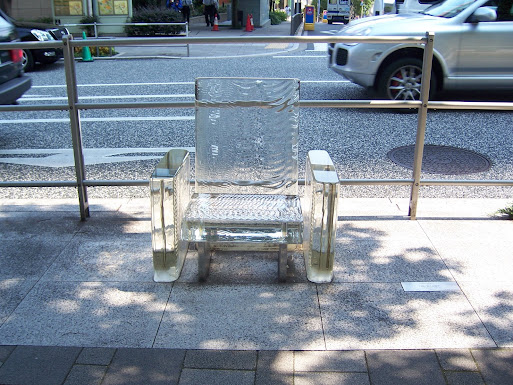
Chair that disappears in the Rain, was a concept created with a similar idea to that of crystal or glass dropped into water; the outlines of these objects gradually disappear, the chair has a similar effect. And thus the idea for "Chair that disappears in the Rain" was born. Installed as a streetscape project, individuals are allowed to interact with the piece.


˚˚˚˚˚˚˚˚˚˚˚˚˚˚˚˚˚˚˚˚˚˚˚˚˚˚˚˚˚˚˚˚˚˚˚˚˚˚˚˚˚˚˚˚˚˚˚˚˚˚˚
for more information please check out the following:

Tokujin Yoshioka
-Tokujin Yoshioka's Website featuring all his work, make sure you take a visit, it features many more equistie works not featured above.

Second Nature by Tokujin Yoshioka

October 30th, 2008
-A great writeup and insight into many of the works included in Tokujin's show 'Second Nature'.